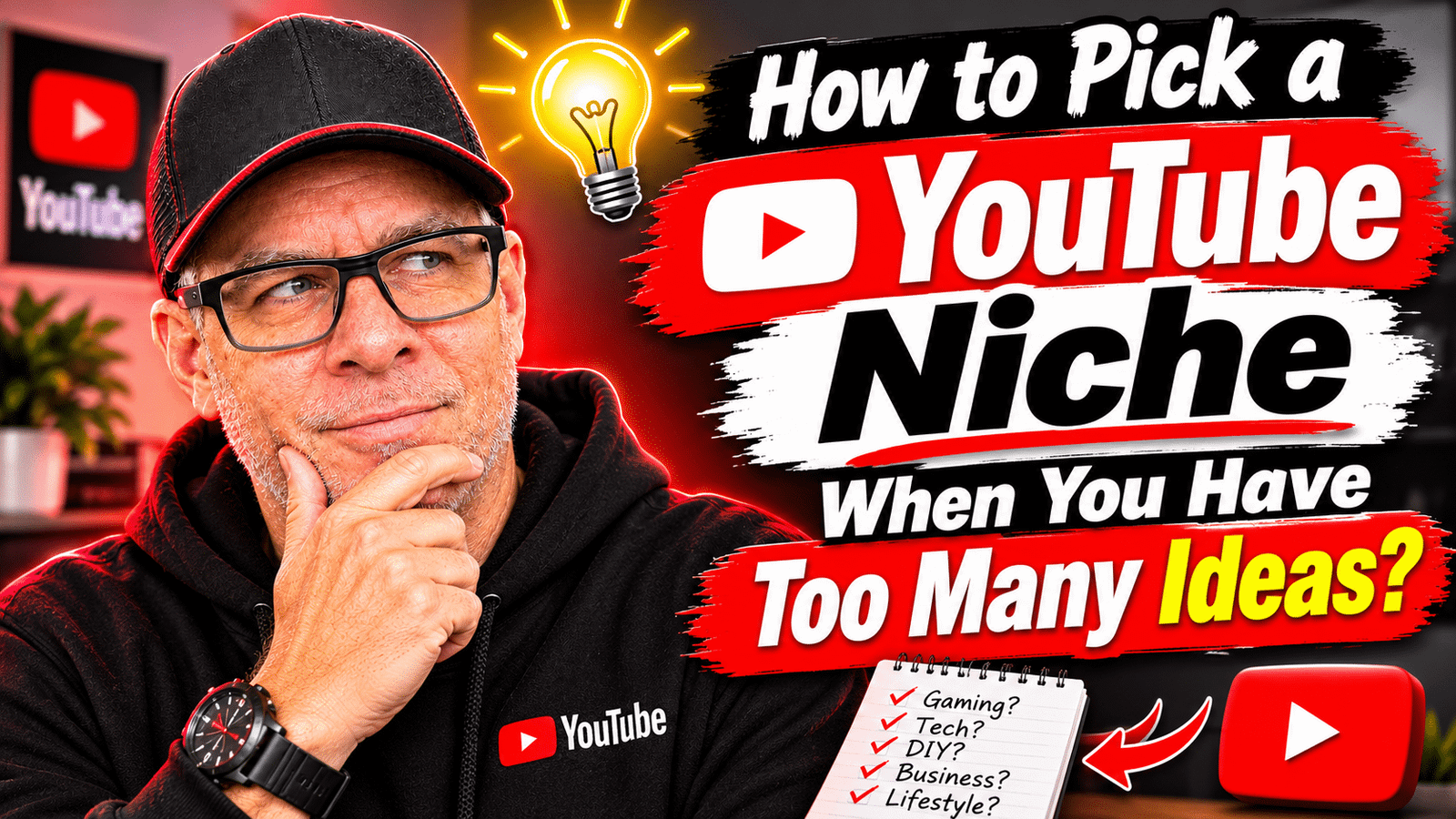
How to Pick a YouTube Niche When You Have Too Many Ideas
Having a long list of video ideas feels productive until you realize none of them are connecting. The real problem is rarely a lack of creativity. It is the lack of a clear decision. That is exactly why how to pick a YouTube niche when you have too many ideas has become one of the most important skills for new and stuck creators.
I’m JV Charles, founder and senior editor at Youtube Made Easy. I talk to a lot of people who are sitting on notebooks full of ideas and zero momentum. The channels that actually grow are the ones that stop collecting ideas and start eliminating them.
Key Takeaways
- Too many ideas usually means you have not forced a decision yet. Clarity beats quantity every time.
- The best niche sits at the intersection of what you can talk about for years, what people are already searching for, and what you can package competitively.
- A tight niche makes how to write YouTube titles and thumbnails easier and improves retention, which directly supports how to get 8,000 watch hours on YouTube.
- You do not need the perfect niche forever. You need a strong enough niche to gain traction and data.
- Testing three focused directions for 30–45 days beats launching ten random channels or constantly switching topics.
Why Having Too Many Ideas Is Actually a Trap
Most creators think their problem is finding the “right” idea. In reality, the bigger problem is refusing to kill the ones that do not serve growth.
When everything feels interesting, nothing gets the depth and consistency required to rank or retain viewers. The algorithm rewards channels that are easy to understand. A scattered channel is hard for both viewers and the system to categorize.
The Three Filters That Cut Through the Noise
When a creator brings me a long list of ideas, we run them through the same three filters.
Filter 1: Can you still care about this in 18 months?
Passion fades. Interest that survives repetition is rarer. If the topic only feels exciting when it is new, it will not carry you through the slow months.
Filter 2: Are people already looking for this?
Search demand and existing successful videos matter. A niche with zero proof of audience interest is a hobby, not a growth strategy. Look at what is already getting views and ask whether you can do a clearer or more useful version.
Filter 3: Can you win the click?
This is where how to write YouTube titles and thumbnails becomes decisive. If you cannot imagine packaging the topic in a way that competes with what is already ranking, the idea is weaker than it looks on paper.
Ideas that survive all three filters are worth testing. Everything else gets parked.
A Simple Decision Process You Can Use This Week
- Write down every idea you currently have. Do not filter yet.
- Cross out anything you would not want to make ten videos about.
- Cross out anything with weak or non-existent search demand.
- Look at the remaining list and ask which one you could package most competitively right now.
- Choose one primary direction and one backup. Commit to 8–12 videos in the primary direction before evaluating.
This process is uncomfortable because it forces elimination. That discomfort is the point.
How Niche Clarity Speeds Up Everything Else
A clear niche makes packaging easier. Titles become more specific. Thumbnails become more consistent. Viewers know what they will get. Retention usually improves because the content matches the promise more tightly.
Better retention and clearer packaging are two of the fastest ways to accelerate watch hours. That matters whether you are chasing the current threshold or preparing for the higher bar under YouTube monetization requirements 2027.
Creators who stay scattered often take much longer to hit the numbers required for how to get monetized on YouTube. Creators who narrow down tend to gather data faster and improve faster.
What to Do If Two Ideas Feel Equally Strong
Run a short, controlled test instead of debating endlessly.
Make three to five videos in each direction with strong packaging. Look at click-through rate, retention in the first 30–60 seconds, and subscriber conversion. Let the early data decide. Most of the time one direction clearly pulls ahead within a few weeks.
Common Mistakes When Choosing a Niche
- Picking something only because it is trending right now
- Choosing a niche you have no real experience or strong point of view in
- Going so broad that the channel has no clear identity
- Switching niches every time a video underperforms
- Waiting for perfect certainty before starting
You will never feel 100 percent sure. You only need to be sure enough to commit for a meaningful test period.
FAQs
Should I pick a niche I already know well or one that is more popular?
Start with what you can speak about with real authority. Popularity without credibility is hard to sustain. The strongest positions usually combine genuine knowledge with proven demand.
How narrow is too narrow?
If you can only think of five video ideas, it is probably too narrow. If you can outline 30–50 solid videos without repeating yourself, the niche has enough room.
Can I change niches later?
Yes. Many successful channels evolve. The goal of the first niche is to gain traction, subscribers, and data so the next decision is informed instead of random.
Does niche choice affect monetization speed?
Yes. A focused niche improves packaging, retention, and session time. Those factors directly influence how quickly you can accumulate the watch hours needed under current rules and the upcoming YouTube monetization requirements 2027.
What if I am interested in multiple overlapping topics?
Look for the overlap. Many strong channels sit at the intersection of two related subjects rather than trying to cover everything separately.
Final Thoughts
Learning how to pick a YouTube niche when you have too many ideas is less about finding the perfect topic and more about developing the discipline to choose. The creators who grow are usually the ones who are willing to disappoint some of their ideas so the best ones can get full attention.
At Youtube Made Easy we push for clarity early because scattered effort is one of the biggest silent killers of channels. Pick the direction that survives the filters, package it well, and give it enough consistent work to produce real data. Then adjust from a position of strength instead of confusion.
The ideas will still be there later. Traction will not wait for you to feel completely ready.
References
- Observed patterns from creator consultations on niche selection and early channel growth (2025–2026)
- YouTube Partner Program requirements and the scheduled February 1, 2027 threshold changes
- Practical packaging and retention principles that support faster progress toward monetization eligibility